
Imagine creating a mysterious substance that pours like a liquid but instantly feels solid when you squeeze it. Oobleck is one of the most exciting hands-on science activities for children and adults alike, combining fun, creativity, and learning in a single bowl. Made from simple household ingredients, this fascinating non-Newtonian fluid offers endless opportunities for sensory play, classroom experiments, and family entertainment.
Whether you’re a parent, teacher, or science enthusiast, this guide will show you how to make perfect Oobleck with ease. Discover different recipe variations, troubleshooting tips, and the amazing science that makes Oobleck so unique.
Best Oobleck Recipe: Flawless Non-Newtonian Slime
Ingredients
Method
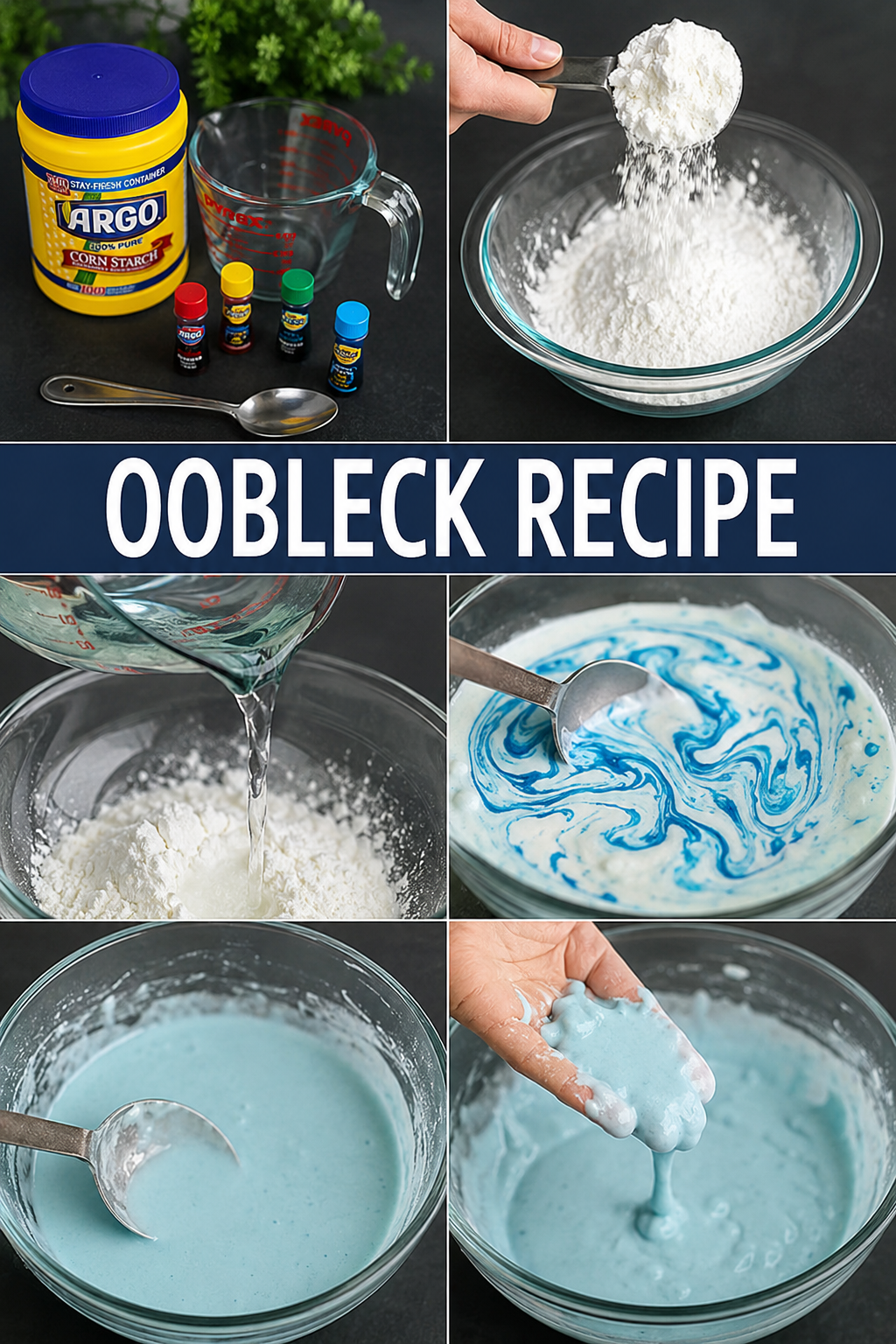
- Set Up: Grab a wide, shallow mixing bowl, baking sheet, or plastic tray to contain the play area and prevent kitchen mess.
- Color the Water: Add 3–4 drops of food coloring directly into your 1 cup of warm water and stir until the color is fully blended.
- Combine: Pour 2 cups of dry cornstarch into your mixing bowl. Slowly drizzle the colored water over the powder.
- Mix: Use your hands or a sturdy spoon to mix gently. At first, you will feel high resistance—keep turning it over until all dry powder disappears.
- The Perfect Test: Scoop some up in your hand; it should melt like liquid syrup. Now, smack the surface with your open palm—if your hand bounces off without splashing, your Oobleck recipe is perfect!
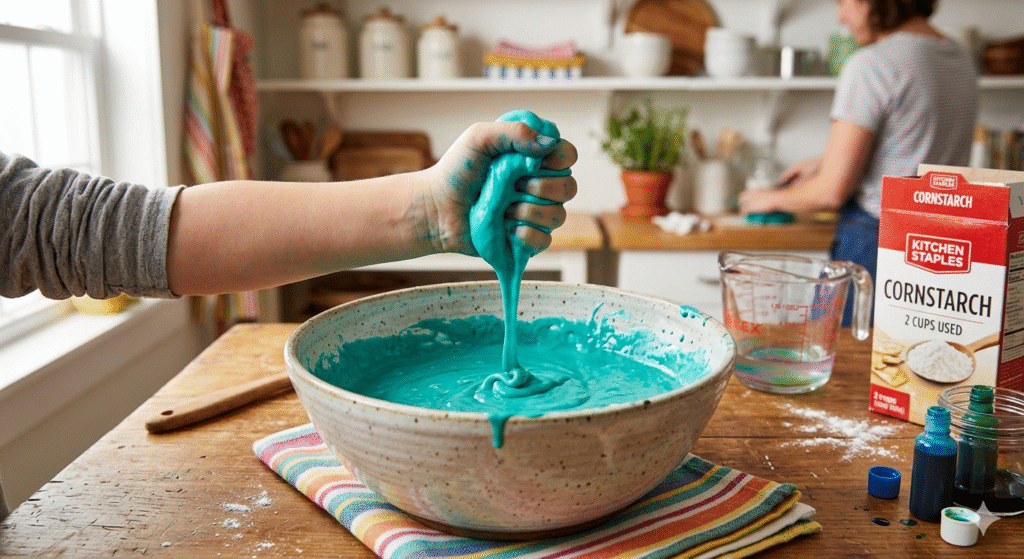
Best Oobleck Recipe: The Golden Ratio for Flawless Science Slime
To create the absolute best version of this mesmerizing substance, you need to follow the exact science of the fluid-to-powder ratio. When balanced correctly, it flows like honey but shatters or hardens when struck hard.
Ingredients:
- 2 cups Cornstarch
- 1 cup Warm Water
- 3–4 drops Food coloring (optional)
Step-by-Step Instructions:
- Prepare Your Station: Grab a wide, shallow mixing bowl or a baking sheet with high edges. This gives you plenty of room to manipulate the slime later.
- Blend the Color: If you want vibrant Oobleck, stir your chosen food coloring directly into the 1 cup of warm water first. This ensures the color distributes evenly without staining your hands during the mixing phase.
- Combine the Ingredients: Pour the 2 cups of cornstarch into your empty mixing bowl. Slowly drizzle the colored water over the powder.
- Mix It Up: Use your hands or a sturdy spoon to mix the ingredients. At first, it will feel highly resistant. Keep stirring gently until all the dry powder disappears.
- The Perfect Test: Scoop some up. It should melt through your fingers like syrup. Now, smack the surface with your open palm—if your hand bounces off without splashing, your master batch is perfect!
Simple Oobleck Recipe: Just 2 Ingredients You Already Have in Your Kitchen
You do not need an expensive trip to the craft store to create sensory magic. The beauty of a truly simple recipe lies in its absolute minimalism. If you have basic kitchen staples, you are already halfway there.
Ingredients:
- 1 part Plain water
- 2 parts Starch powder (Cornstarch or Arrowroot powder)
Step-by-Step Instructions:
- Measure: Grab any standard kitchen mug or measuring cup. Pour two scoops of starch into your container.
- Hydrate: Add exactly one scoop of tap water to the powder.
- Stir Slowly: Because this recipe relies on keeping things straightforward, don’t rush the mixing. Gently turn the starch over into the water until it liquefies. If it feels a bit too stiff to even move, add half a teaspoon of water to loosen the tension.
The Ultimate Oobleck Recipe Without Cornstarch (Easy Alternatives Revealed)
Ran out of cornstarch? No problem at all. You can easily achieve that classic liquid-to-solid shift using alternative household starches. Tapioca flour or potato starch work beautifully as substitutes, offering a slightly glossier, unique texture.
Ingredients:
- 2 cups Tapioca flour (or Potato starch)
- 1 cup Boiling water (Note: Alternative starches often require warm-to-hot water to activate correctly)
- Food coloring (optional)
Step-by-Step Instructions:
- Heat the Water: Warm your water until it is hot but safe to touch. Alternative starches bind differently than cornstarch and react better to heat.
- Measure the Substitute: Place 2 cups of tapioca flour or potato starch into your mixing basin.
- Slow Integration: Pour the hot water into the starch gradually, stirring constantly with a heavy wooden spoon to prevent tough lumps from freezing up early.
- Knead to Finish: Once cool enough to touch, use your hands to knead the mixture until it transitions into a glossy, smooth fluid that hardens beautifully under pressure.
Oobleck Recipe in Cups: Easy-to-Follow Measurements for Mess-Free Mixing
Using clear cup measurements keeps the entire process exceptionally neat, straightforward, and easy for young kids to understand without making a massive mess on your countertops.
Ingredients:
- 2 standard measuring cups of Cornstarch
- 1 standard measuring cup of Water
- A plastic tray or rimmed baking sheet for containing the play area
Step-by-Step Instructions:
- Level the Cups: Fill your measuring cup with cornstarch, scraping the top flat so the measurement is precise. Dump it into the middle of your play tray. Repeat for the second cup.
- Pour the Liquid: Fill a single measuring cup to the very top line with clean water.
- Gradual Blending: Pour exactly half of the water cup onto the cornstarch heap and mix. Once the water is absorbed, pour the remaining half cup. This controlled method keeps fine white powder from flying into the air and settling over your kitchen surfaces.
Quick Oobleck Recipe Small Batch: Perfect for One-Person Sensory Play
If you only want a tiny amount for a quick desk toy, an individual sensory tray, or a single child’s afternoon experiment, a small-batch approach is the cleanest choice.
Ingredients:
- 1/2 cup Cornstarch
- 1/4 cup Water
Step-by-Step Instructions:
- Select a Small Vessel: A cereal bowl, a Tupperware container, or even a sturdy paper bowl works perfectly for this size.
- Add Components: Drop the 1/2 cup of cornstarch straight into the bowl, followed immediately by the 1/4 cup of water.
- Finger Mix: Use just two fingers to stir the small mixture together inside the bowl. Within 30 seconds, you will have a neat, personal-sized ball of non-Newtonian fluid ready to play with right at your desk.
Oobleck Recipe for Classroom: Fun, Safe, and Mess-Managed Group Science
Bringing this experiment into a school environment requires a distinct approach focused on scale, clean-up efficiency, and student safety. This recipe is designed to serve a larger group of students while minimizing clean-up time.
Ingredients (Bulk Scale for ~5–6 Students):
- 1 large box of Cornstarch (approx. 16 oz or 4 cups)
- 2 cups of Water
- Large, shallow plastic storage bins or aluminum roasting pans
- Wet wipes and a bucket of warm water for quick handwashing
Step-by-Step Instructions:
- Prep the Stations: Divide your students into small groups and give each group a large plastic storage bin. This keeps the mixture entirely contained away from desks and floors.
- Distribute the Powder: Empty one full 16-ounce box of cornstarch directly into each group’s bin.
- Delegate the Pouring: Have one student slowly pour 2 cups of water into the bin while the other children use their hands to knead the mixture together.
- Interactive Learning: Encourage the students to roll the mixture into a solid ball, then open their hands to watch it melt back into the bin as a fluid.
- Classroom Cleanup: When play is over, let the students scrape their hands clean over the bins. Use wet wipes for their skin first, and let the bins sit overnight. The next day, simply dump the dried, crusty powder straight into the trash can.
The Silky Soft Oobleck Recipe with Conditioner: A No-Water Sensory Twist
Replacing water with hair conditioner results in an incredibly smooth, aromatic, and pillowy sensory compound. While it behaves slightly less like a traditional fluid, it offers an intensely soft tactile experience that keeps hands clean and smells fantastic.
Ingredients:
- 2 cups Cornstarch
- 1 cup Inexpensive hair conditioner (scented or unscented)
Step-by-Step Instructions:
- Measure into a Bowl: Place 2 cups of cornstarch into your container.
- Add the Conditioner: Pour 1 cup of hair conditioner directly over the powder.
- Knead Thoroughly: Use a spoon initially, then switch to your hands to thoroughly work the conditioner into the starch.
- Adjust Consistency: If the mixture feels a bit too crumbly like dough, squeeze in an extra tablespoon of conditioner. If it feels overly sticky, dust it with a pinch of cornstarch until it transitions into a incredibly silky, dough-like fluid.
Is There a Safe Oobleck Recipe Borax Variation? What You Need to Know
Traditional Oobleck does not contain borax. Slime recipes often use borax as a chemical cross-linker to create stretchy polymer chains, but true Oobleck relies strictly on physical pressure and starch suspension. If you are looking to combine the traits of both, here is how to navigate a starch-and-glue style hybrid safely.
Ingredients:
- 1/2 cup Washable school glue
- 1/2 cup Cornstarch
- 1/4 cup Warm water
- Note: Avoid actual commercial borax powder if you want to keep this recipe purely food-safe and skin-friendly for young toddlers.
Step-by-Step Instructions:
- Emulsify the Glue: Mix 1/2 cup of school glue with 1/4 cup of warm water in a bowl until thin and uniform.
- Thicken with Starch: Slowly stir in the 1/2 cup of cornstarch.
- Achieve the Hybrid State: This specific configuration behaves like a highly dense, slow-moving putty. It retains some of that classic non-Newtonian pressure resistance while remaining stretchy and cohesive like traditional slime.
The Fascinating Science Behind Your Homemade Oobleck Recipe
Why exactly does this simple combination of kitchen ingredients behave so strangely? The secret lies in a concept called shear thickening.
Cornstarch particles are microscopic, jagged, and rough. When mixed with water, they do not dissolve; instead, they remain suspended in the liquid. When you move through the mixture slowly, the water flows smoothly around each grain of starch, allowing them to slide past one another effortlessly like a liquid.
However, when you apply sudden force, hit the surface, or squeeze a handful quickly, you instantly squeeze the water out from between the starch grains. The jagged friction causes the particles to lock tightly together, instantly mimicking a hard solid. The moment you release that pressure, water slips back between the grains, and the substance liquefies instantly once more.
Troubleshooting Your Oobleck Recipe: How to Fix Too Watery or Too Crumbly Slime
Sometimes, humidity levels or minor measuring errors can throw off your mixture’s balance. Luckily, fixing it is incredibly straightforward.
- If your mixture is too watery: If it looks like regular milk and doesn’t harden when you poke it quickly, you have too much liquid. Sprinkle in 1 tablespoon of cornstarch at a time, mixing thoroughly after each addition, until the surface resists sudden taps.
- If your mixture is too dry or crumbly: If the substance breaks apart into chalky, dusty chunks and refuses to flow at all, it lacks hydration. Add warm water just a few drops at a time. Be careful—a tiny bit of water goes a remarkably long way!
- If it gets sticky: Sticky mixtures mean the starch is overwet. Dust your hands with dry cornstarch and work it back into the pool until it cleanly peels away from your skin when pressurized.
Conclusion
Making a homemade Oobleck recipe is one of the most rewarding, low-cost, and intellectually stimulating sensory activities you can explore. From classroom science demonstrations to quick individual playtime setups, its unique physics properties never fail to inspire awe. By mastering the basic two-ingredient ratio and understanding how to adjust, substitute, and scale your batches, you can easily guarantee a perfect, non-Newtonian experience every single time. Enjoy getting your hands dirty, exploring the physics of shear-thickening fluids, and watching a solid melt away right before your eyes!

